Posted: November 5th, 2011 | No Comments »
Found this most interesting –
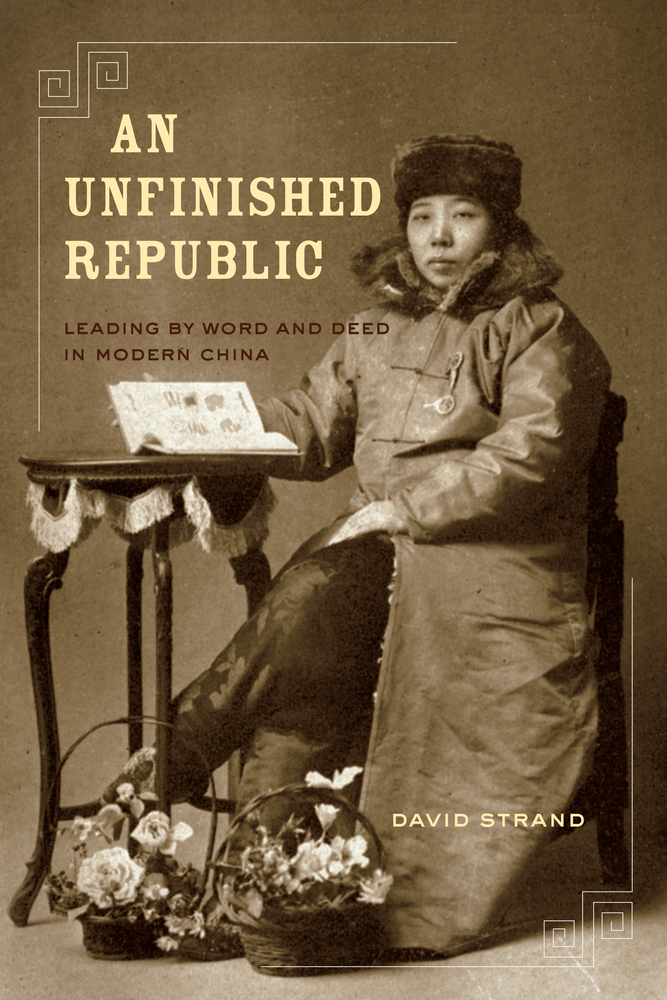
An Unfinished Republic by David Strand. As usual details below plus an online chapter worth reading
here.
In this cogent and insightful reading of China’s twentieth-century political culture, David Strand argues that the Chinese Revolution of 1911 engendered a new political life—one that began to free men and women from the inequality and hierarchy that formed the spine of China’s social and cultural order. Chinese citizens confronted their leaders and each other face-to-face in a stance familiar to republics worldwide. This shift in political posture was accompanied by considerable trepidation as well as excitement. Profiling three prominent political actors of the time—suffragist Tang Qunying, diplomat Lu Zhengxiang, and revolutionary Sun Yatsen—Strand demonstrates how a sea change in political performance left leaders dependent on popular support and citizens enmeshed in a political process productive of both authority and dissent.
ABRIDGED -Chapter 1:
The Chinese Revolution also traversed a geographic expanse to rival in magnitude its longevity as a historical process. The landscape of its politics was vast not only because Qing conquests in the seventeenth and eighteenth centuries doubled the size of the preceding Ming dynasty, bequeathing a gigantism only a few nations exhibit, but also because critical sites of the revolution extended far beyond China's borders, to East and Southeast Asia, America and Europe. As political lives unfolded in a long revolution, they also crossed boundaries of hometown or village, province, country, and continent. The history of revolutionary thought and action winds through exile and immigrant communities in cities like Tokyo and San Francisco, work, study, and training experiences in Lyon, New York, and Moscow, and diplomatic postings in Paris and St. Petersburg. Seeds of revolutionary thinking about rights and social justice were sown in China by returning officials, students, workers, and merchants, with the help of foreign visitors like globe-trotting suffragists and Comintern agents.
An inveterate traveler by force of circumstance as a political refugee twice, from 1895 to 1911 and from 1913 to 1916, and also by choice and conviction as a political campaigner, Sun Yat-sen eventually found travel so vital to his purposes that he declared it a "necessity" for everyone along with "food, clothing and shelter." Sun would have been lost without steamships and trains. He traveled to raise money and plot revolution but also to collect slogans and insights for the struggle back home. Returning to China in 1911, Sun continued to journey around the country by train, boat, and the occasional sedan chair. Sun was not alone in embracing what Marie-Claire Bergère has termed in his case "extreme geographic mobility" as a political response to the vastness of China itself, the expanse of "Greater China" in Diaspora, and the pressing fact of a global context for national and even local events. The accelerated opening up of China to the world brought change in every area of life. A 1918 essay titled "The Woman Problem" in the progressive journal New Youth noted that because of the "dense networks of transportation and communication" that now bound the world as one, "what is happening in European societies today will happen in our society tomorrow." With transoceanic telegraph lines in operation, tomorrow might actually mean the next day if not week, month, or year. By the 1880s Shanghai was served by most international steamship lines. The reciprocal opening up of the world to Chinese with the means and motivation to travel made geographic mobility a stimulus to political thought and a credential that might induce others less traveled to agree with you. Leaving home, and returning changed, helped make the case for a New China.
Upon his return to his home province of Hunan in 1913 after ten years of study in Japan, Britain, and Germany, the scholar Yang Changji, Mao's college teacher and the father of his future wife, Yang Kaihui, wrote an article for the local Changsha magazine Public Word titled "My Opinions on Reforming Society." Yang noted that as a result of the political revolution that took place while he was away in Tokyo, Aberdeen, and Berlin, "China has experienced tremendous change in the transformation of its political system into a republic, the profound nature of which can hardly be expressed." He cited the end of the imperial examination system, cutting of Manchu-style queues on men and boys, banning of foot binding for girls, and suppression of opium. Yang still retained powerful attachments to Confucian thought and criticized what he saw as excessive Western reliance on self-interest in ethical matters. Yang also embraced the urgent need for social change and attacked customs like arranged marriage and concubinage. Pressing ahead on these fronts "loudly" was needed in order to "reach the ears of those who are still deaf." "Recently," Yang wrote, "I have lived and traveled in several countries both East and West, asking after customs and examining how customs change. There is a great benefit in doing so since the way change actually takes place is through international communication. By comparing customs, the good and the bad become visible." The good in the West for Yang included fundamentals like free speech and small pleasures like not having family members read your mail. The bad in China ranged from poor public hygiene to fellow scholars failing to return borrowed books.
In Changsha one can visit the teacher's college where Yang Changji held forth as the "Confucius of First Normal" and Mao Zedong was his student. There are also less prominent historical sites like a small museum in a turn-of-the-century house dedicated to another Hunan native, Li Fuchun. One of the architects of the new socialist economy of the 1950s, Li spent 1919 to 1924 in France where he joined the Chinese Communist Party and, briefly, in the Soviet Union studying revolution. Among the exhibits in the museum are postcards Li sent from Paris, a leather document case from his post-1949 party service, eyeglasses, and a large map titled "The Tracks of Li Fuchun's Life." On the map one can follow Li from his birth in Changsha to journeys throughout China, including a visit to Beijing to study French, his participation in the Long March, and battles in Northeast China during the final civil war with the Nationalists in the late 1940s. Once he took his place in the central bureaucracy in the 1950s, aside from a diplomatic visit to Moscow in 1952, plotting out Li's life becomes a matter of tracking his ascent through ministries in Beijing rather than charting domestic and international travels.
Li's early sojourns in Paris and Moscow are represented by a small inset map. Such cartographic devices typically show a detail of a larger map, like the city plan of Changsha on a map of Hunan Province. Here, instead, geographic details of places once remote and unfamiliar, like France and Russia, find their way onto a map of China. Even Mao Zedong, whose "tracks" did not lead out of China until his 1950 mission to Moscow to meet Stalin, as a young man began a walk through five counties of Hunan after he read about two other students who journeyed on foot all the way to Tibet. Later Mao traveled widely in China not only on revolutionary business but also for more personal reasons, to visit the hometown of Confucius in Shandong Province as a tourist and to Beijing to woo Yang Kaihui.
As Sun Yat-sen intuited early in his career, China's gigantic size and poorly defended borders represented challenges to national governance but also opportunities for individual growth and political careers. Documenting and interpreting the movement of early-twentieth-century politicians and activists requires attention to these global details. As a recent study of the Republic's place in the world suggests, this was, for many, especially men and women of ambition, an "age of openness." In Republican China, "everything important had an international dimension."
This moving and globalized picture of revolutionary politics-in-the-making is at odds with the by now discredited stereotype of Chinese as "earthbound tillers." In a revolutionary era one expects individuals, ideas, and organizations to be set in motion as tradition is uprooted. In fact, late imperial China was already moving according to its own rhythms. Scholars traveled to attend school, take the official examination, and assume office in the capital or a distant province. Merchants journeyed far in search of profits. Though ordinary people might wish to remain on ancestral lands, they were often forced to move by war, natural disaster, or economic distress. Even relatively earthbound farmers moved around quite a bit within the circuits of the market towns that surrounded them.